Mother Teresa: A Life of Service
A life of service, compassion and global influence — from a Loreto classroom in Calcutta to canonisation as Saint Teresa of Calcutta.
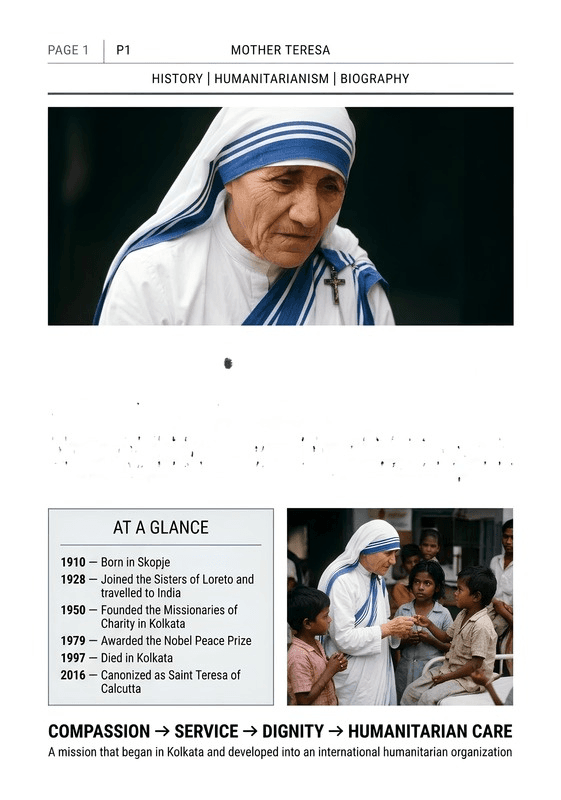
Mother Teresa (1910–1997) was a Catholic nun and humanitarian who became internationally known for her work with poor, sick and homeless people in Kolkata, India. Through the Missionaries of Charity, she developed a global humanitarian mission centred on serving people experiencing poverty, illness, abandonment and dying.
She was born Agnes Gonxha Bojaxhiu on 26 August 1910 in Skopje, then part of the Ottoman Empire and now the capital of North Macedonia. Growing up in a Catholic family of Albanian heritage, she developed an early interest in religious life and missionary work. At eighteen, in 1928, she left home to join the Sisters of Loreto, travelling first to Ireland and then to India, arriving in Calcutta in January 1929. Her early years in India were spent within the Loreto community, where she taught at St. Mary's School and gradually developed the experiences that would later shape her humanitarian mission.
The Turning Point
For almost two decades, Sister Mary Teresa worked within the Loreto community in Calcutta, teaching and eventually becoming principal of St. Mary's School. In 1946, while travelling by train from Calcutta to Darjeeling, she experienced what she later described as a profound inner calling to serve people directly in need. This experience became an important turning point in her life. Over the following years, she sought permission to leave the convent life of the Loreto community and establish herself among the poor of Calcutta. The transition was gradual, but it ultimately led toward the creation of a new humanitarian mission.
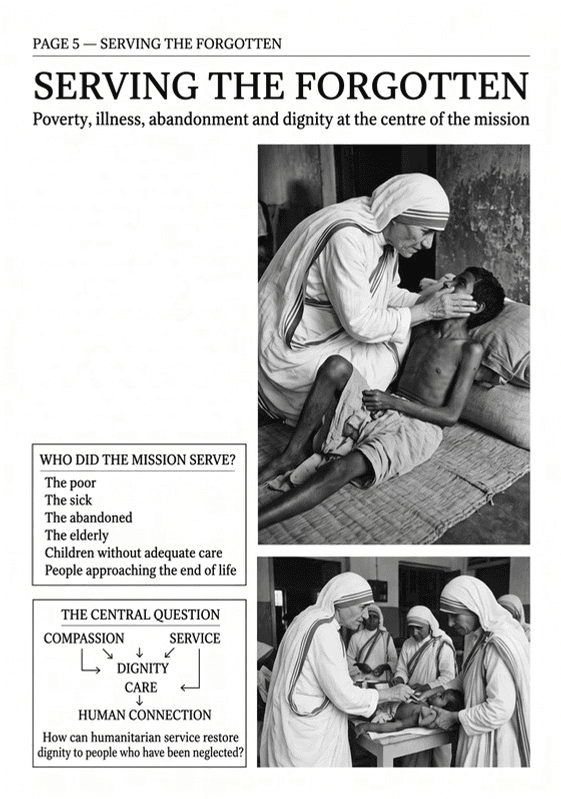
The core purpose of that mission was serving people who are poor, sick, abandoned or dying, through homes, orphanages, hospices, food programmes, relief programmes and community service. Mother Teresa became internationally associated with direct service to people living in extreme poverty, illness, abandonment and difficult social circumstances. The Missionaries of Charity established homes and facilities intended to care for people who were often neglected by wider society, and her public image became closely connected with the personal act of caring for people who had few other sources of support. Her approach emphasised simple service, human dignity and direct contact with people in need.
International Recognition
By the later decades of the twentieth century, Mother Teresa had become one of the world's most recognisable humanitarian figures. The Missionaries of Charity expanded beyond India, while Mother Teresa travelled internationally, met political and religious leaders, received major awards and continued to draw global attention to poverty and human suffering. Her public image became closely associated with the simple white sari with blue borders and the direct, personal style of service practised by her organisation.
In 1979, she was awarded the Nobel Peace Prize for her humanitarian work. In 1980, she received the Bharat Ratna, India's highest civilian award. These honours transformed her from a widely known humanitarian figure into one of the most internationally recognised personalities associated with twentieth-century humanitarian service.
Admiration and Criticism
- The admiration: humanitarian service, global recognition, personal dedication, and the expansion of the Missionaries of Charity.
- The criticism: questions raised about medical care standards, financial transparency, and relationships with donors and political figures.
Sainthood
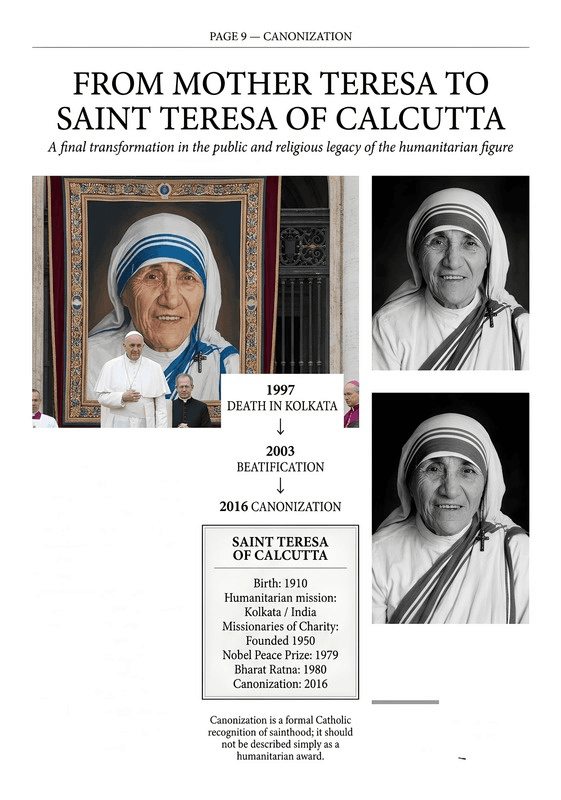
After her death in 1997, Mother Teresa's reputation continued to develop through public remembrance, Church recognition, and the ongoing work of the Missionaries of Charity. She was beatified in 2003. In 2016, Pope Francis formally canonised her as Saint Teresa of Calcutta at a Mass in St. Peter's Square at the Vatican — a final recognition that completed her transition from a globally admired humanitarian worker into an official icon of faith and devotion, one whose public image continued to extend far beyond Catholic communities.
The lasting significance of Mother Teresa lies not only in the institutions she helped create or the honours she received, but in the question her life continues to raise: how should society respond to people who are most vulnerable?
Editorial Standards & Transparency
Our Editorial CodeThis article was commissioned, edited, and fact-checked in accordance with Vision News’s editorial policies. Commercial partners and advertisers do not review or influence our reporting. If you believe this piece contains a factual error, please notify our corrections desk at hello@visionnews.uk.